The Moon Is Howling
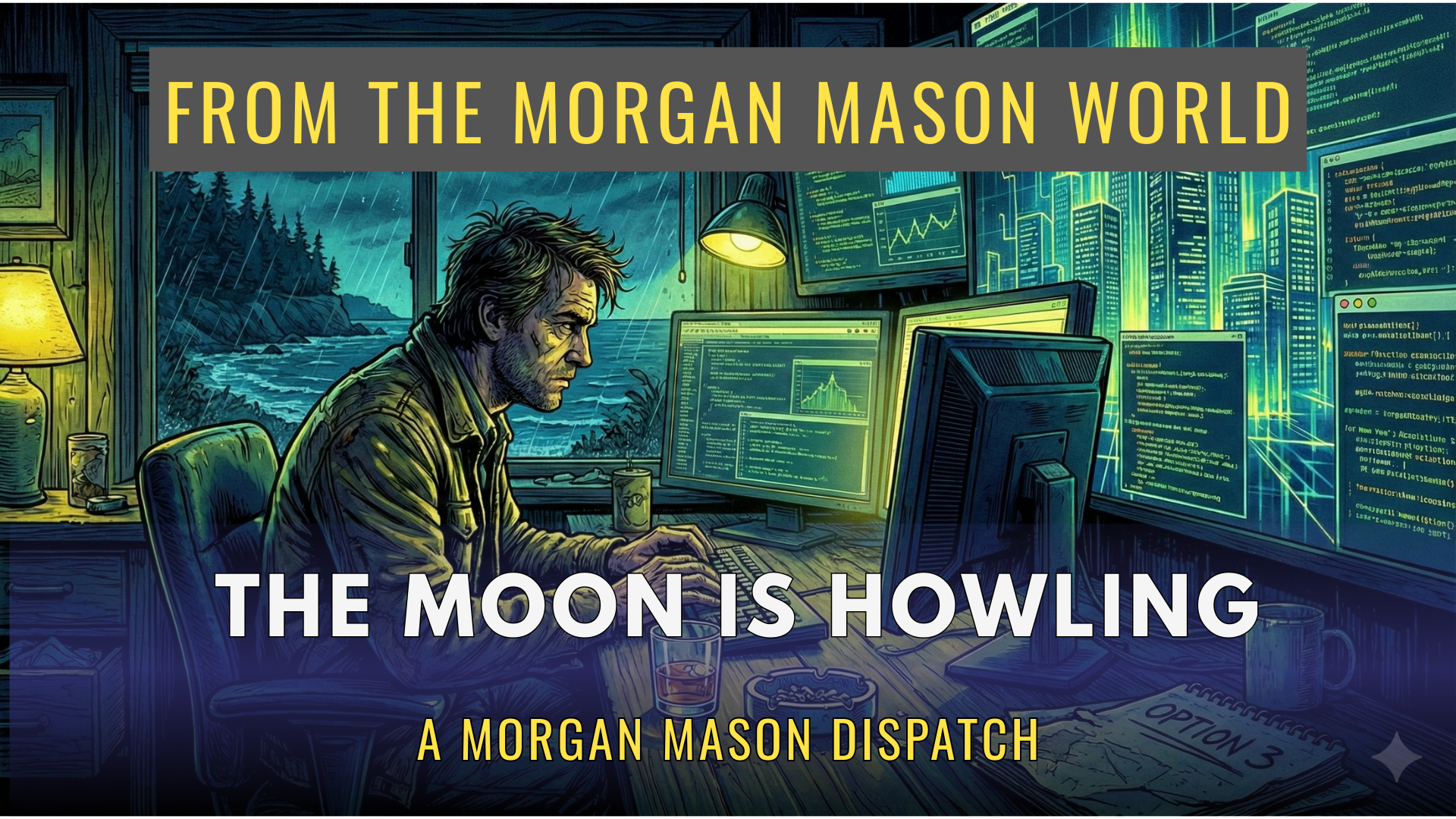
Morgan Mason is a recurring fictional character in a few of my stories and a current book-length work in progress. His bio is that “he’s a journalist, a washed out magazine exile, and a part-time arsonist of institutional reputations. He writes about the parts of America that creak when the lights are off. Once a respected magazine editor, now a proud Substack exile, he documents the country’s descent in real time. Truth is his vice of choice, and like all good vices, it’s slowly killing him. He writes with a cigarette in one hand, a drink in the other, and a camera roll full of stories someone definitely didn’t want recorded. If a story doesn’t burn going down, he doesn’t publish it.”
Here’s his latest Substack post:
Morgan Mason | Substack | January 2026
In a time of universal deceit, the truth may first appear as graffiti.
Which is unfortunate, because graffiti is also where you find the full spectrum of human consciousness: everything from Bob Dylan to bowel distress.
That’s not a metaphor. That’s geography.
When I was in college and living off campus, our neighborhood tavern was a proper dive – sawdust on the floor some nights like the owners were trying to absorb the sins committed on the premises. I played a lot of pool there. Made a reasonable amount of money, too, mostly off guys who believed confidence was a substitute for understanding trigonometry and English.
The men’s room was the kind of place you didn’t so much enter as you survived. And on one wall, alone like it owned the building, someone had written:
Sometimes the moon howls and the wolves are silent.
Opinions varied. “Crazy shit.” “Dylan Thomas-level.” “A guy having a King-hell dump after a late-afternoon burrito run.” The weird thing about it was this: nobody wrote over it. For years, it sat there by itself. No doodles. No phone numbers. No second opinions.
In a room where people couldn’t be trusted to hit a toilet bowl, they still had enough reverence – or fear, or whatever that is – to leave a sentence alone.
That’s how you know it landed.
Because when a society starts going low-trust, it gets weird in specific ways. People stop believing in institutions, but they don’t stop believing in messages. They just start hunting for them in stranger places. The official channels begin to sound like theater: bright lights, rehearsed voices, everybody smiling like they’ve got equity.
Meanwhile, the wall is blunt. The wall doesn’t have a brand strategy. The wall doesn’t care if you “feel seen.” The wall just says the thing.
And in a world where everything feels rigged, that’s what starts to count: not whether a statement is certified, but whether it feels like it came from an actual human being with something to lose.
Now – let me be clear before someone emails me a six-paragraph lecture that begins with “As a journalist…”: yeah, I know graffiti isn’t automatically true. Plenty of graffiti is just noise. Plenty of it is propaganda. Plenty of it is cruelty wearing a cheap mask. And I’m not even referring to graffiti in a solely literal sense, I’m including all the forms of non-official communications.
But the reason graffiti starts to feel like truth in a low-trust world is simple:
It isn’t trying to sell you anything.
It’s not asking for your vote. It’s not asking for your money. It’s not asking you to subscribe, donate, or click. It’s not wrapped in legal language designed to mean nothing while sounding responsible.
It’s just a mark left by somebody who couldn’t stand the silence.
And if you want the real definition of “rigged,” it’s this: not that the powerful always win. The powerful have always had their thumb on the scale. The rigging is when the entire system starts insisting – loudly, repeatedly, with a straight face – that there is no thumb.
That’s when the moon starts howling.
And the wolves – the old enforcers, the people and systems who used to keep the story honest through fear, accountability, consequence – go quiet.
Now, once you’ve admitted the wall can sometimes tell the truth, you run straight into the next problem: what happens when the people with the microphones decide the wall is their competition?
That’s where the Solzhenitsyn thing comes in – the thing people pass around online like a cigarette in a prison yard:
“We know that they are lying… but they are still lying… the lie has become… the pillar industry…”
Here’s the maddening part: that long “they know we know” tongue-twister looks like a folk paraphrase actually got stapled to Solzhenitsyn’s name after the fact, like a joke that wandered into a library and stole a jacket.
But the core idea – the lie as infrastructure – is absolutely Solzhenitsyn. In his Live Not by Lies essay, he basically says the regime doesn’t need you to love it; it needs you to participate in the daily deceit, and he even calls out refusing to buy papers that “distort or hide” the facts.
And that’s why the quote, even in its Frankensteined form, hits like a brick through a window: it describes a specific kind of public sickness: the era of the known lie.
Not the old-fashioned lie where somebody tries to fool you. The new lie where everybody in the room knows it’s a lie and the speaker keeps going anyway, because the point isn’t persuasion anymore.
The point is dominance.
It’s not “believe me.” It’s “repeat after me.” It’s “pretend with me.” It’s “prove you’re on the team by swallowing something you can taste is false.” It’s “bend the knee.” Once you’ve done that a few times, you’re compromised. You can’t easily turn around and claim you’re a clear-eyed independent thinker, because your own mouth is on the receipt.
That’s how a low-trust society is manufactured. Not by one big propaganda broadcast. By a million little moments of social coercion where the safest move is to nod along and keep your head down.
And nobody does that better than politicians, because politicians have learned the two magic tricks of succeeding in modern life:
· You can say anything as long as it fits the tribe’s narrative.
· If you get caught, you don’t apologize – you accuse.
The correction becomes the crime. The fact-check becomes an “attack.” The question becomes “bad faith.” You don’t answer. You counterpunch. You don’t clarify. You brand.
Meanwhile the media – yes, that media, including the ones with tasteful fonts and a self-image so earnest it could be laminated – has its own version of the same sickness. Because the business model quietly mutated while we were busy yelling at each other.
In the old story we tell ourselves, a paper like the New York Times, the Washington Post, or any major outlet that wants to be seen as the adult in the room, is supposed to be a lighthouse: you navigate by it even when you don’t like the weather.
In the new reality, it’s often more like an aquarium: beautifully lit, carefully curated, and filled with creatures that have never once had to survive the ocean.
That doesn’t mean everything they publish is wrong. It means the incentives are warped. The institution has to protect its access, its status, its self-concept, its readership segments, its internal politics. And when those things collide with messy reality, you start seeing a very specific kind of coverage:
· stories that feel pre-written, where facts are allowed in only if they behave
· “both-sides” performances where the truth is treated like an opinion
· euphemisms so gentle they could tuck a war crime into bed and kiss it goodnight
· narratives that don’t lie outright, but select so aggressively that you end up living in a terrarium
And once the public senses that selection – once people realize they’re being managed – trust doesn’t just decline. It curdles.
Because then the suspicion, quite reasonably, becomes: If they’re curating this hard, what are they protecting?
That’s when the wall starts talking again. Thoughts the powerful don’t want you to see start blooming overnight on the wall. Or X. Or Substack. Same impulse, different wall.
And this is the part where Solzhenitsyn stops being some heroic Soviet ghost and becomes a mirror you don’t want to look into. In Live Not by Lies, his move isn’t “storm the palace.” It’s smaller and more humiliating: stop cooperating. Stop repeating what you don’t believe. Stop signing your name to things you know are false. Stop rewarding institutions that hide reality behind polite language.
In other words: the lie only survives through participation. Not just through the liar.
Which brings me to the most American detail of this whole mess: we’ve managed to build a society where the lie isn’t just tolerated – it’s monetized. It’s packaged. It’s focus grouped. It’s A/B tested. It’s pushed through a funnel. It’s turned into content. And then it’s sold back to you as identity.
That’s what “everything feels rigged” really means. It’s not one conspiracy. It’s worse than that.
It’s a thousand aligned incentives – political, corporate, media, academic, tech – pulling in the same direction: toward control of the story. Toward narrative dominance. Toward “trust us” with no reciprocal accountability.
And the moment you notice that, you start seeing the difference between information and performance.
Performance is when a politician delivers a speech that answers no real question but hits every emotional button like a drummer in a stadium band.
Performance is when a newsroom confuses “responsible tone” with truth and treats skepticism as rudeness.
Performance is when institutions demand trust as a down payment rather than earning it like rent.
And the public – God bless us, the public is not stupid – starts reacting the only way people can react when they feel trapped inside a rigged game:
They either tune out…
or they start watching for graffiti.
Not because graffiti is holy. Because graffiti is unlicensed. Because it hasn’t been smoothed down to fit the approved shape of reality. Because it might be the burrito guy dealing with earlier bad choices, yes.
But every once in a while, it’s the moon howling.
And the wolves – our supposed guardians of truth – are staring straight ahead, silent, pretending not to hear it.
All right. Here’s the part nobody puts in the glossy “decline of institutions” essay, because it isn’t philosophical – it’s logistical. Low trust isn’t just a mood. It’s a tax. It’s friction. It’s rot in the gears.
The Hidden Price Tag Of Low Trust
In a high-trust society, you can do a hundred small things on autopilot. You can assume the waiter isn’t poisoning you. You can assume the mechanic won’t steal your car to fund a second family. You can assume the hospital isn’t going to run your insurance like a casino. You can assume the fine print isn’t a trap door.
That’s what high trust really is: low transaction costs. Less paperwork. Less verification. Less paranoia. Less time spent wondering if you’re being played.
When trust drops, everything gets slower. Not because people get dumber – because people get defensive. Institutions start building systems that treat everyone like a suspect, because they’ve been burned too many times, and because it’s cheaper for them to burden you than to clean up their own mess.
So now you live in a world where you have to prove you’re you every time you try to do anything remotely adult.
Want to cancel a subscription? We’re going to need your firstborn, the last four digits of your soul, and a security question you answered in 2009 while half-asleep.
Want to talk to a human being? Great. First, please scream “representative” into the void like you’re summoning a demon. Then enjoy forty-five minutes of pan flute music and a recorded voice promising your call is important – in the same tone a mugger uses right before he asks for your wallet.
Want to dispute a charge? Fill out this form. Then upload a PDF. Then print the PDF and sign it. Then scan it. Then upload it again. Then call this number to confirm you uploaded it. Then wait ten business days while we “investigate,” which in modern English means “we’re hoping you die.”
Low trust breeds bureaucracy because bureaucracy is the institutional version of not making a decision.
And because nobody wants to take responsibility anymore, everything becomes policy. Scripts. Checklists. Compliance language. “We’re sorry you feel that way.” The great triumph of modern governance and modern corporate life is that we’ve created a system where nothing is anyone’s fault, but everything is still somehow always your problem.
That’s the first daily-life symptom of a rigged world: you feel like you’re constantly negotiating with a machine that has no face and no memory and no shame.
The Scam Economy Blossoms
And here’s the second symptom: scammers thrive.
Scammers love low-trust societies the way mosquitoes love standing water.
Because when trust collapses, people don’t stop wanting certainty. They stop getting it from credible places. So, they go shopping for it.
That’s when the grifters show up with their little carts of certainty:
“Here’s the real story they don’t want you to know.”
“Here’s the secret reason your life feels worse.”
“Here’s the one weird trick the elites fear.”
“Here’s the thread. Here’s the video. Here’s the guy in a car yelling confidently.”
“Here’s the subscription. Here’s the course. Here’s the supplement. Here’s the coin.”
Low trust does something cruel: it makes the truth harder to sell than the lie.
Truth is usually complicated, incremental, nuanced, conditional. Truth says, “We don’t know yet.” Truth says, “It depends.” Truth says, “Here’s what we can prove, here’s what we can’t, here’s what would change my mind.”
The lie says: “I know exactly what’s happening, and I’ll tell you in exchange for your attention.”
Guess which one gets more clicks.
So, you end up living in this double bind where the official systems feel rigged and the unofficial ones feel feral, and your brain – a normal human brain that just wants a solid floor – starts trying to build certainty out of scraps.
That’s where the graffiti metaphor turns from cute to grim.
Because the wall doesn’t just carry truth. It carries all the competing stories that rush in when the center fails. Propaganda. Rage. Despair. Genius. Delusion. The full human stew.
The wall is a marketplace, and the currency is emotion.
The Social Vibe Turns Adversarial
And then comes the third symptom, the one that actually changes who you are: people get meaner.
Not cartoon-villain meaner. Defensive meaner. Suspicious meaner. “I’m not going to get played again” meaner.
You see it in driving. You see it in customer service. You see it in online conversation, where everyone argues like they’re trapped in a hostage video and their captor is making them say the dumbest thing imaginable.
In high-trust societies, we give each other the benefit of the doubt. In low-trust societies, we start looking for angles.
You begin to assume that:
the stranger is filming you
the cashier is upselling you
the friend is virtue-signaling you
the boss is setting you up
the politician is lying to you
the reporter is spinning you
the expert is protecting a career
the company is hiding a fee
the institution is laundering a narrative
Sometimes, hell, often that suspicion is justified. Often it isn’t. But once it becomes your default, it changes the texture of life. It makes ordinary interactions exhausting, like you’re constantly scanning for hidden knives.
And the worst part is: the people at the top often benefit from this.
Because a low-trust society can’t organize. It can’t cooperate. It can’t agree on the shape of reality long enough to do anything ambitious. People become isolated and angry and easy to herd.
That’s why “rigged” is so corrosive. It doesn’t just mean “unfair.” It means futile. It means why bother?
And once “why bother” becomes the dominant emotion in a society, you don’t need a tyrant. People will do the tyrant’s work for him by withdrawing from civic life, from community, from anything that requires mutual belief.
The wolves go silent. Not because they don’t exist.
Because they’ve realized silence is safer than consequence.
The Quiet Solution Isn’t Glamorous
Which brings us back to Solzhenitsyn’s annoying little moral dare: don’t participate in the lie.
This is where everyone wants the cinematic answer: a revolution, a purge, a hero, a viral moment that fixes it. But the real repair is painfully unsexy. It’s boring, repetitive, and local:
It’s refusing to repeat what you don’t believe.
It’s asking for receipts.
It’s rewarding the outlets that correct themselves.
It’s admitting when you were wrong.
It’s not sharing the thing that feels deliciously scandalous until you can verify it.
It’s building pockets of high trust inside the wider low-trust mess.
Because here’s the thing: you can’t rebuild trust at the national scale first. That’s like trying to refill a lake with a teaspoon.
You start with small bodies of water.
Families. Friend groups. Neighborhoods. Professional circles. Little institutions that still have consequences. People who still feel shame when they lie. Systems where truth isn’t just a moral virtue, it’s an operational requirement.
That’s what high trust is, at the end of the day: accountability you can touch.
And this is where my bathroom-wall philosopher earns his keep again.
“Sometimes the moon howls and the wolves are silent.”
In a high-trust society, the wolves answer. They correct. They protect the commons. They take the heat and do the job.
In a low-trust society, the wolves are either domesticated, bribed, exhausted, or quietly replaced by dogs trained to wag at the camera.
So the moon howls.
And you find yourself standing in the men’s room of a dive bar, staring at a sentence that may have been written by a poet or a man in gastrointestinal distress, and realizing something that should make every institution in America break into a cold sweat:
The wall is starting to feel like the most honest thing in the building.
Who Benefits When Everything Feels Rigged?
Here’s where the conversation gets stupid fast, because the minute you ask who benefits, half the country starts hearing atonal, jarring movie-soundtrack sounds and looking for a corkboard and red string.
So let me say it plainly: you don’t need a single mastermind for a society to become rigged. You just need a bunch of powerful actors – politicians, platforms, media companies, consultants, donors, and the professional outrage class – who discover, independently and simultaneously, that low trust is profitable.
It’s not always a conspiracy. Sometimes it’s just alignment. Like a murmuration of starlings. Or hedge fund managers at a funeral.
Low trust turns out to be an extremely efficient fuel source because it does three things at once:
It lowers the standard of proof.
When people don’t trust institutions, they stop demanding rigor from anyone. They demand vibes. They demand a comforting narrative. They demand somebody who sounds certain. Certainty is the cheapest product on earth to manufacture.It raises emotional volatility.
Fear, anger, humiliation, and resentment are click engines. They don’t require evidence. They especially don’t require coherence. They just require a target.It breaks collective action.
A low-trust society can’t coordinate long enough to fix anything. Everyone assumes everyone else is cheating, so nobody wants to be the sucker who plays fair.
That third one is the jackpot. Because once the public can’t coordinate, the winners don’t have to win an argument. They just have to outlast you.
Now – who benefits?
Politicians Benefit First
Of course they do. Because low trust turns politics into a protection racket.
In a high-trust society, politicians must persuade you that their plan is better. In a low-trust society, they just have to persuade you that the other side is dangerous and the referees are corrupt. The pitch becomes:
“Don’t listen to them, they hate you.”
“Don’t listen to the press, they’re lying.”
“Don’t listen to the experts, they’re bought.”
“Only I can protect you from the rigged system.”
That’s not policy. That’s marketing. And it’s effective because it offers something people want more than truth: safety through belonging.
Once a politician convinces you the world is rigged against you, they can fail constantly and still keep your loyalty, because every failure becomes evidence of the rigging. And the lack of evidence is simply proof of how deep the conspiracy goes – not because it’s true, but because it’s psychologically convenient. It’s a self-sealing argument. A political perpetual motion machine.
And then they do the smartest move of all: they don’t just attack the other team. They attack the concept of neutral judgment. Courts, elections, auditors, journalists, scientists, career civil servants – anyone who could adjudicate reality becomes “part of it.”
Because if nobody is trusted to call balls and strikes, then every pitch is whatever the pitcher says it is.
Media Benefits Too – Even The “Good” Media
Not because every newsroom is twirling a mustache, but because the incentive structure is basically a laboratory-designed addiction.
Outrage is measurable. Nuance isn’t.
Outrage converts. Nuance makes people tired.
Outrage keeps you refreshing, doomscrolling, waiting for the next hit. Nuance makes you close the tab, go outside, take the dog for a walk, and possibly become emotionally stable – which is terrible for quarterly earnings.
So even respectable outlets – especially the ones who consider themselves the “adults” – get trapped. They have to compete in the same attention economy as the guy livestreaming from a truck while yelling at clouds and crying. And that competition changes you.
It pushes you toward:
framing everything as existential
treating politics like sport
optimizing for shareability
and, worst of all, confusing tone with truth
That last one is lethal. Because when people sense that the voice is “responsible” but the selection is rigged, they stop believing the paper isn’t just another tribe with a nicer font.
Once trust is gone, media becomes less a public service and more a set of identity vendors. Not “Here’s what happened.” More like: “Here’s how a person like you should feel about what happened.”
And it fucking works. It works because in low-trust times, people don’t just want information. They want permission.
Tech Platforms Might Be The Biggest Beneficiaries Of All
Because low trust is engagement, and engagement is money. Lots and lots of money.
A high-trust society produces boring feeds. People read the news, shrug, pay their taxes, mow the lawn, maybe go to a school board meeting if they’re feeling spicy.
A low-trust society produces infinite content:
scandals
conspiracies
takedowns
“receipts”
counter-receipts
performative apologies
the apology to the apology
and a ten-part thread explaining why the apology is actually fascism
The platforms don’t have to invent any of this. They just have to amplify what performs. And what performs is emotion, conflict, and certainty.
So they become the perfect delivery system for the “known lie” culture. Not because they love lying, but because they love the metrics lying produces.
But, you ask, is it deliberate?
Here’s my answer: parts of it are deliberate, and most of it is opportunistic.
There are deliberate strategies that show up again and again, because they work. You see them across ideologies, countries, and media ecosystems, because they’re not moral philosophies – they’re tactics.
Flood the zone. Overwhelm people with so many claims and counterclaims that they give up on knowing anything. Confusion isn’t a side effect; it’s the point. A confused public can’t coordinate.
Kill the referees. If you can delegitimize every institution that might verify reality, then reality becomes tribal. There is no truth – only alignment.
Weaponize hypocrisy. You don’t need to be clean. You just need to convince your side that “everyone does it,” so their moral disgust turns into resignation.
Turn mistakes into proof of corruption. If people start treating ordinary human error as a conspiracy, then every correction becomes evidence of the cover-up.
Make people feel mocked. This one is underrated. When you can frame institutions as condescending – “those people think you’re stupid” – you don’t just win an argument, you trigger a deeper, older reflex: humiliation. People will burn down a city to stop feeling humiliated.
And yes, there are people who understand all of that and use it with purpose. Not always from some grand plan, but from the simple recognition that a fragmented, distrustful public is easier to rule.
But here’s the more unsettling truth: even without deliberate planning, the system rewards the same behavior, so everyone who wants power ends up learning the same moves. Like predators evolving the same teeth on different continents.
That’s how you get a society where the lie becomes a pillar industry without anybody needing to hold a secret meeting.
Low trust is a strategy sometimes.
Most of the time it’s a business model.
So What Would Reversing It Actually Require?
Not slogans. Not “unity.” Not a national group hug sponsored by a bank.
It would require consequences.
High trust is not built on good vibes. It’s built on the belief that lying is expensive.
When public officials lie, they lose careers.
When media outlets get things wrong, they correct fast, prominently, and with humility – without treating their audience like children. When it happens repeatedly, the outlet dies.
When platforms amplify scams, they pay a real cost, not a PR cost.
When powerful institutions fail, they don’t hire a consulting firm to write a report about how they have “opportunities for improvement.” They change, visibly, or they shrink.
And at the personal level – because this is where Solzhenitsyn’s annoying little dare keeps coming back – people stop participating in the lie. Not dramatically. Just stubbornly.
You don’t repeat what you don’t believe.
You don’t share what you can’t verify.
You don’t reward people for speaking confidently when they’re clearly bullshitting.
You build little pockets of trust where truth is not a moral posture, but a requirement for functioning.
That’s not a revolution. It’s janitorial work.
But janitorial work is how civilizations stay inhabitable.
Midnight On Orcas
Anyway.
I started this piece a few hours ago and it’s after midnight. This winter’s rain has been treating Orcas Island like a politician treats the truth: unrelenting, insistent, and mildly mean-spirited. The rain has been pounding on the metal roof all evening. The trees out beyond the porch are black shapes against an even darker sky, and the water out there in the channel is doing that thing it does in the dark: pretending it’s empty while it moves like a living animal. You can’t see it, but you can’t pretend it isn’t there.
I’ve got the last swallow of scotch in the glass, and I’m looking at it the way you look at any small comfort you know doesn’t solve the big problem.
The moon, if it’s up there, is behind a wall of clouds. The wolves are wherever they are – silent, or sleeping, or domesticated, or gone. And somewhere – maybe in a bar bathroom, maybe under an overpass, maybe in a corner of the internet no one is focused on yet – somebody is writing the first draft of what we’ll all pretend we believed later.
I’ll finish the scotch and listen to the rain for a minute longer than necessary, because that’s what you do when you live in a place like this and you still want to believe some things can be simple.
Selah.