Waiting for the Apocalypse (and Other Hobbies)
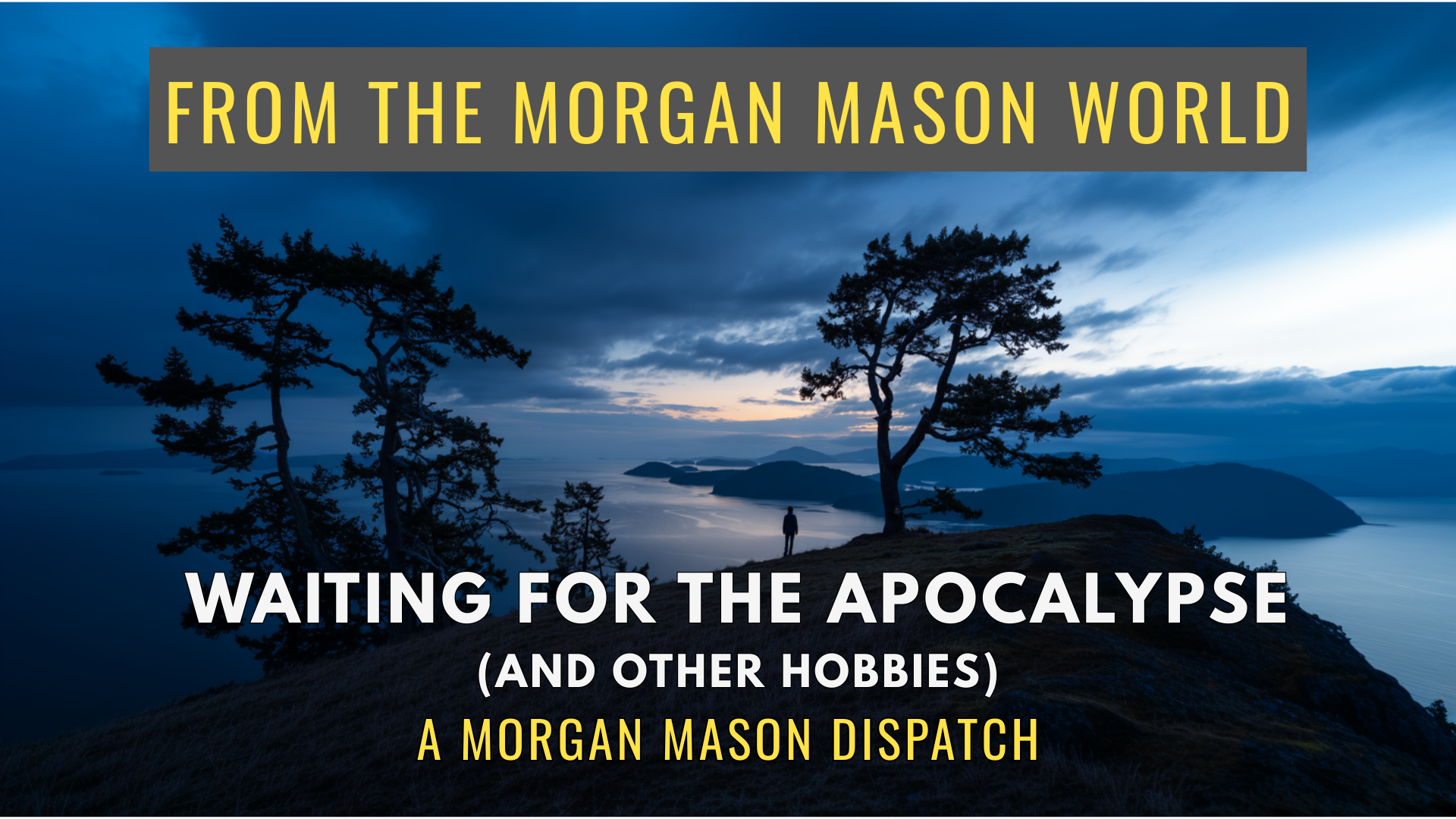
Morgan Mason is a recurring fictional character in a few of my stories and a current book-length work in progress. His bio is that “he’s a journalist, a washed out magazine exile, and a part-time arsonist of institutional reputations. He writes about the parts of America that creak when the lights are off. Once a respected magazine editor, now a proud Substack exile, he documents the country’s descent in real time. Truth is his vice of choice, and like all good vices, it’s slowly killing him. He writes with a cigarette in one hand, a drink in the other, and a camera roll full of stories someone definitely didn’t want recorded. If a story doesn’t burn going down, he doesn’t publish it.”
Here’s his latest Substack post:
Morgan Mason | Substack | December 2025
A Year-End Meditation on Survival, Collapse, and Why the Rent's Still Due
It's 2 AM on Orcas Island, the end of December in 2025 bleeding into January 1st, 2026, and I've lived through the end of the world eight times now.
Still here. The laptop still boots. The Substack subscriptions still process on the first of the month. The Salish Sea still laps against the rocks below my cabin with the same indifferent rhythm it's maintained for ten thousand years.
The rent, despite everything, is still fucking due.
I'm not a doomsday prepper. I don't have a bunker stocked with freeze-dried meals and ammunition. I'm not an optimist either—optimists don't make it in journalism longer than a year before reality beats it out of them or they transition to PR. I'm just a guy who's been told THIS IS IT enough times to recognize the pattern.
And here's the pattern: the apocalypse keeps getting scheduled. Keeps getting hyped. Keeps getting monetized. And then keeps not quite arriving the way we were promised.
Let me walk you through it.
I. Y2K (1999-2000): The Boring Apocalypse
I was twenty-one, fresh into Army intelligence training at Fort Gordon. They had us on standby for infrastructure collapse. Power grids failing. Banking systems zeroing out. Nuclear launch codes scrambling because some programmer in the 1960s figured two digits for the year was plenty and why would anyone need more?
We sat in ready rooms watching CNN count down to midnight. Times Square. London. Tokyo. Sydney got there first—we watched Australian TV feeds showing absolutely nothing happening except drunk people celebrating.
Midnight came for us. Nothing happened. Not a goddamn thing.
Turned out the apocalypse had already been prevented by ten thousand programmers nobody remembers, adding two digits to date fields in COBOL code decades older than I was. They saved civilization and got shitty severance packages when their contracts ended on January 2nd.
First lesson: the apocalypse gets canceled by boring technical work nobody notices. Salvation doesn't look like heroes. It looks like pocket protectors, legacy code maintenance and overtime pay.
II. 9/11 (2001): Everything Changed (Then Didn't)
This one was supposed to be real.
And it was—three thousand people dead, buildings falling, the whole apparatus of American invincibility revealed as theater. Everything changed, they said. They were right. Just not the way they meant.
We didn't end. We just spent twenty years turning airports into security theater and pretending surveillance was patriotism. We traded civil liberties for the feeling of safety. We got neither but we took our shoes off and let minimum-wage workers in blue wearing Santa hats this time of year cop a feel as we went through security before flights.
Second lesson: apocalypse doesn't end civilization. It just makes it more paranoid and less honest about what it's doing. The collapse happens in what you accept as normal afterward.
III. Iraq (2003): The Apocalypse as Sales Pitch
Weapons of mass destruction. Mushroom clouds. Smoking guns. The whole apparatus of fear deployed by people who knew better, aimed at people who wanted to believe.
I was at the Presidio at Monterey watching intelligence reports get shaped into certainties. Watching "maybe" become "definitely" become "imminent threat." Pattern recognition is useful until you recognize the pattern is bullshit and you're in the room where it's being generated.
The apocalypse was real this time too. Just not the one they sold us. Turned out the apocalypse was bad intelligence weaponized by people with agendas, killing hundreds of thousands, destabilizing a region for decades. We're still paying interest on that particular civilizational debt.
Third lesson: sometimes the apocalypse is just lies that sounded important at the time. Sometimes the mushroom cloud is PowerPoint presentations in secure facilities. Sometimes Armageddon has a marketing budget.
IV. The Financial Collapse (2008): Too Big to Fail, Too Big to Punish
This was supposed to be The Big One for capitalism. Global economic meltdown. Banks failing. Retirement accounts evaporating. Great Depression 2.0: This Time It's Computerized.
I was writing at The Frequency by then, watching my friends lose their jobs as publications folded or fired half their staff. The apocalypse looked like finding out you were laid off when your access to the company network got cut off, severance packages calculated to the day, and form rejection e-mails to job applications.
Except it wasn't the end. It was just wealth transfer at gunpoint. The banks that were "too big to fail" got bigger. The people who caused it got bonuses. The people who lost everything got advice about resilience and grit and other words that mean "you're on your own."
Fourth lesson: the apocalypse is never too big to fail. Just too big to punish. Collapse is something that happens to regular people. The system just calls it correction and moves on.
V. Net Neutrality (2017): The One I Was Sure Would Get Me
Okay, this sounds stupid now. But in 2017, I genuinely thought losing net neutrality was civilizational collapse.
Not civilization broadly. My civilization specifically.
The internet—the last semi-democratic space, the thing that made independent journalism possible after magazines died, the infrastructure I'd built my entire post-magazine career on—was about to become cable TV. Tiered access. Corporate gatekeeping. Comcast deciding which websites loaded fast enough to bother with.
I spent weeks documenting contingencies. Where would I host if Substack got throttled? How would readers find me if Google prioritized corporate media? What was the fallback if the open web became a walled garden?
This was the one that would kill people like me. Not dramatically. Bureaucratically. Just wake up one day and discover the platform doesn't work anymore and nobody cares because they're watching Netflix.
And then... nothing happened. Or everything happened. Hard to tell.
The web got worse. But not catastrophically. Just incrementally. Death by a thousand paywalls and algorithm changes and platforms prioritizing engagement over information. The apocalypse arrived as terms of service updates nobody read.
Fifth lesson: the apocalypse doesn't arrive as one big event. It arrives as a thousand small degradations you learn to navigate until you forget what you lost. The collapse is a subscription model. You pay monthly and barely notice the service getting worse.
VI. Trump/January 6th (2016-2021): The Apocalypse as Fundraising Opportunity
Democracy dies in darkness. Or daylight. Or Twitter. Depending on who you asked and which e-mail fundraiser they'd just received.
The apocalypse was supposed to be fascism. Or it was supposed to be resistance to fascism. Or it was supposed to be the discourse about fascism creating the conditions for actual fascism. Hard to tell when everyone's using eschatological language for political donations.
I watched journalists I respected describe every policy decision as existential threat to democracy. I watched that language get so overused it stopped meaning anything. Boy who cried wolf except the boy has a blue checkmark and a Patreon.
Sixth lesson: nothing ends when everyone's making money predicting the end. The apocalypse becomes content. Content becomes revenue. Democracy dies but the discourse about democracy dying gets killer engagement numbers.
VII. COVID (2020-2022): The Boring Apocalypse Returns
Finally. An actual apocalypse with bodies.
Pandemic. Refrigerated trucks serving as morgues. Economy frozen. Civilization on pause. The apocalypse arrived as exponential growth curves and stay-at-home orders and the weird discovery that half of all jobs were bullshit that could be done remotely or not at all.
Except we didn't end. We just Zoomed. I attended my first Zoom memorial service when my buddy Frank died in 2021.
We ordered DoorDash. We bought Pelotons. We argued about masks and called it politics. We created an entire economy around the apocalypse—grocery delivery, curbside pickup, contactless everything. The end times adapted to market conditions.
Two years later we all pretended it was over because we were bored and tired of it. Million dead Americans but brunch was back so we called it endemic and moved on.
Seventh lesson: turns out the apocalypse is boring. And if it's boring long enough, we just declare it finished and go back to whatever we were doing before. Grief has a statute of limitations. So does paying attention.
VIII. [Select Your Own Apocalypse] (2025): The Apocalypse as Multiple Choice
And here we are again. The end times. For real this time. Definitely.
AI's going to kill us all or save us all or something in between that's too complicated to reduce to a headline but simple enough to generate investment capital.
Climate's already killing us but slowly enough that we keep scheduling meetings about it and setting net-zero targets for 2050, which is far enough away that everyone making the promises will be dead before anyone checks if they delivered.
Democracy's dying but also fundraising off its own death, which suggests it's not dying fast enough to stop accepting donations.
The apocalypse is here. Or coming. Or overdue. Or already over and we're living in the aftermath. Depending on which newsletter you subscribe to.
Eighth lesson: TBD. Check back next year. If there is one.
So What's the Pattern?
Eight apocalypses teach you something. Not what you'd expect. Not how to prepare or what to stock or which bunker to buy.
They teach you this: the apocalypse is always happening.
I’ve quoted Thompson’s 1970s wave essay more times than is strictly legal for a man my age. The high-water mark where everything peaked before rolling back. That place where you could see the exact moment everything changed.
But what if there was no peak? What if it's been rolling back the whole time and we're just noticing different parts of the shoreline?
We're not waiting for the apocalypse. We're living in it. This IS the collapse. Just slower and more administrative than we expected.
Entropy doesn't arrive as explosion. It arrives as forms to fill out, systems that stop working, infrastructure that degrades until nobody remembers what it used to do. The apocalypse looks like calling customer service and waiting on hold for forty-five minutes before getting disconnected. It looks like prescription costs tripling while insurance covers less. It looks like infrastructure built in the fifties finally giving up while nobody can agree on how to fix it.
The collapse is here. We've just normalized it.
But Here's Where It Gets Weird
Because while I've been cataloging apocalypses, someone else has been selling salvation from them.
There's a whole fucking industry now built on the premise that the apocalypse is internal. Not nuclear war or climate collapse or democratic backsliding. Your own body. Your own mind. Your own mortality.
The toxins. The stress. The inflammation. The anxiety. The aging. Your body is the catastrophe.
Same people who'll tell you climate change is overblown will spend five hundred dollars on supplements to optimize their mitochondria. Same people who tell you that democracy's in mortal danger will pay ten grand for a meditation retreat to process “collective trauma.” Who’s got that kind of time?
We can't agree on which apocalypse is real. But we can agree that you, personally, are in crisis and need to buy something about it.
It's Gnosticism for people who do hot yoga. The body is both temple and prison. The world is corrupt but you can transcend it—not through prayer, through optimization. Original sin is inflammation. Salvation is the right morning routine. Heaven is living to 150 with perfect biomarkers.
At least the Puritans were honest: you're doomed and maybe God saves you. The wellness cult says you're doomed and you can save yourself for $499 per month plus shipping.
I've covered some of these people. Wellness entrepreneurs. Longevity gurus. Biohacking evangelists. The ones who've turned mortality into market opportunity and built empires selling supplements with ingredients you can't pronounce to people terrified of ingredients they can't pronounce.
They're not wrong that the body degrades. They're not wrong that modern life is toxic. They're just wrong that individual optimization is salvation.
You can't biohack your way out of systemic collapse. You can't supplement your way out of climate change. You can't cold-plunge your way out of fascism. You can't optimize your morning routine while infrastructure fails and call it transcendence.
But you CAN make a fortune selling people the fantasy that personal wellness equals civilizational immunity. That if you just drink enough filtered water and take enough adaptogens and track enough biomarkers, you'll be fine while everything else burns.
That's not wellness. That's just capitalism discovering a new way to monetize fear. The apocalypse becomes another thing you're failing at personally. Another optimization problem. People toasting, “New Year, new me” signing up for another wellness subscription.
So What's the Real Apocalypse?
If it's not nuclear war or plague or Net Neutrality or your cortisol levels?
It's this. What we're doing right now.
Documenting the collapse instead of preventing it. Reading about disaster instead of organizing against it. Optimizing our personal lives while collective infrastructure fails. Arguing about whether the apocalypse is real while living in it.
The apocalypse is living in the end times and calling it normal.
It's infrastructure that used to work and doesn't anymore. Try getting a human on the phone at your bank. Try getting healthcare without fighting your insurance company like it's a divorce negotiation. Try buying a house on a regular salary. Try believing your vote matters when districts are gerrymandered by the same politicians who told you last year that gerrymandering was the Devil’s tool and campaigns are funded by people whose names you'll never know.
It's institutions that used to function and now just extract. Healthcare, education, housing—all financialized, all collapsing, all charging you more while delivering less.
It's the sense that everything's gotten worse but nobody can quite say when it started or how to stop it.
It's knowing your water's contaminated and your air's polluted and your democracy's collapsing and doing nothing because there's nothing one person can do. So you subscribe to newsletters about it. You read articles documenting it. You feel informed and helpless in equal measure.
That's the real apocalypse. Not the dramatic one. The boring one.
Where everything slowly stops working and we all just... adapt. Complain. Subscribe to more newsletters about the collapse. Get premium subscriptions for ad-free collapse content. Build careers documenting the end times while the end times continue.
I'm doing it right now. You're reading it. We both feel smart. Nothing changes.
It's 3 AM Now
Bourbon's lower in the bottle. Fog's rolling in off the Salish Sea. Same fog. Every night. The apocalypse has a schedule and keeps it religiously.
I've survived eight apocalypses. I'll probably survive whatever 2026 brings. Not because I'm smart or prepared or resilient.
Because the apocalypse isn't coming. It's here. And it's fucking boring. And it's slow. And it's profitable for the people selling you solutions to it.
Maybe Thompson was wrong and there was no wave. Maybe it's been rolling back the whole time and we're just noticing different parts of the shoreline.
Every generation thinks they're living through the end. Every generation's right. The apocalypse isn't an event. It's a process. Entropy. Degradation. The universe returning to its default state: indifferent chaos.
We try to build meaning. We build systems. We build civilizations. And the universe, patiently, takes them apart. Not dramatically. Bureaucratically. Not with a bang. With forms filed in triplicate and budget cuts and infrastructure deferred until later and later never coming.
The rent's still due. The subscriptions still process. The bourbon still pours.
If this is Hell, at least the bourbon's better than I expected.
That's not survival. That's just Wednesday in the end times.
See you next year. If there is one.
Morgan Mason writes from Orcas Island, Washington, where he documents the Machine's slow self-consumption. His newsletter covers technology, politics, and the various ways systems fail while pretending to function. He's not religious but he knows eschatology when he sees it. Subscribe for weekly dispatches from the end times. They're not getting any less apocalyptic.