The Joker's Gospel of Despair
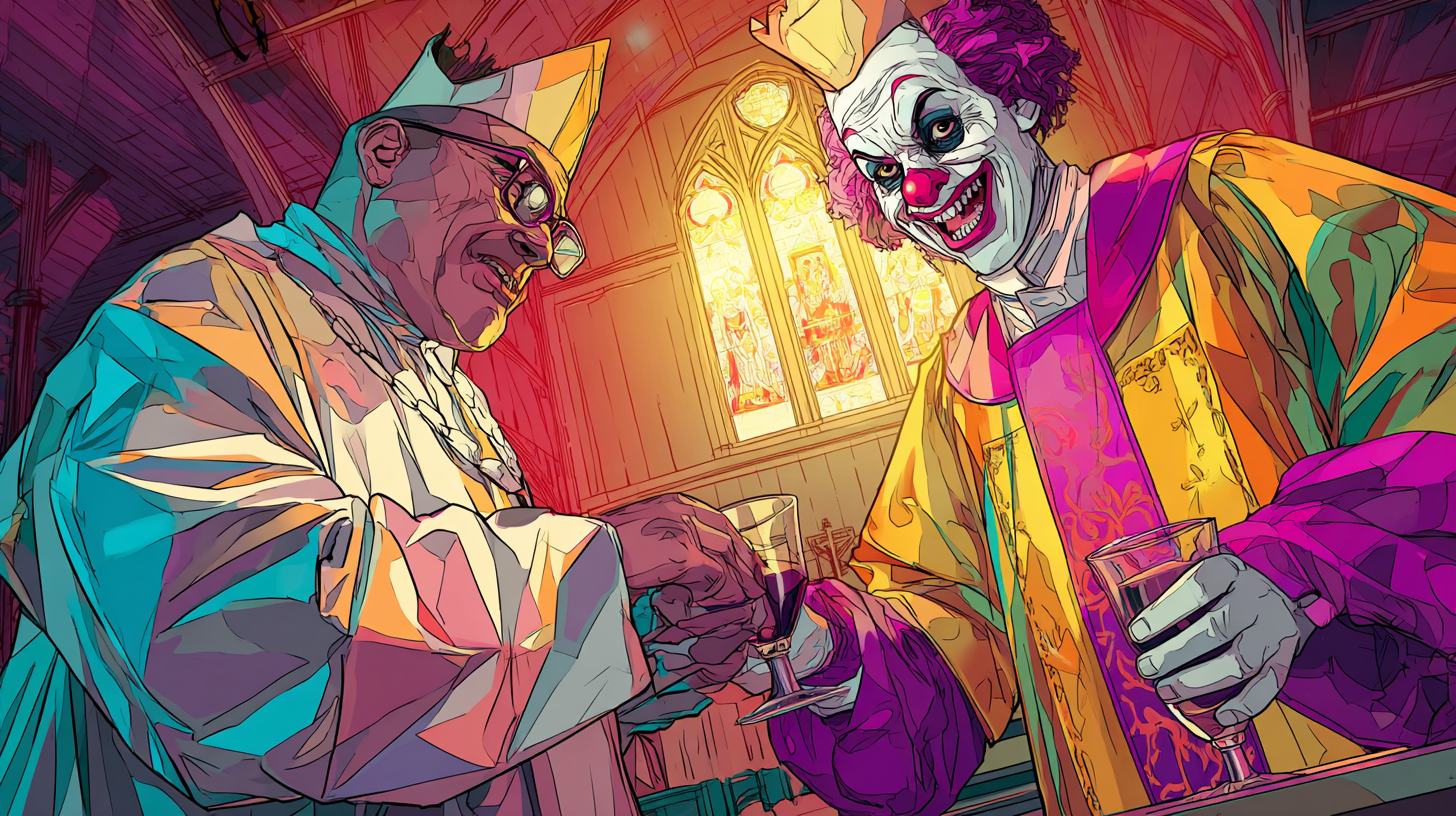
Pauline Anthropology, Catholic Grace, and the Clown Who Denied Easter
In the first post in this series, I compared Randall Flagg and the Joker as two faces of chaos—one building empires on the ruins he created, the other holding up a mirror to prove the ruins were always there. Today I want to dig deeper into what makes the Joker so theologically unsettling, especially if you understand the Christian framework he's weaponizing.
Because here's the thing: the Joker doesn't reject Catholic teaching on human brokenness. He weaponizes it. St. Paul diagnoses the wound; the Joker rubs salt in it. Paul offers a resurrection; the Joker offers a punchline.
The Interrogation Room as Confessional
The interrogation room in The Dark Knight is a concrete box with fluorescent lights and a two-way mirror. Batman slams the Joker's head against the metal table. Blood mixes with white greasepaint. The clown only laughs.
Between blows, the Joker says, “…you have nothing to threaten me with."
He's not asking for mercy. The Joker has turned the confessional inside out. Absolution in reverse. Instead of hearing your sins and offering penance, he hears your pretensions and offers proof of your hypocrisy.
Let's walk through the ruins of Gotham and see where grace and despair diverge.
Shared Diagnosis: They Both Believe You're Broken
St. Paul never met the Joker, but he'd recognize the lab rat. Paul's letters to the Romans lay out one of Christianity's most uncomfortable truths: we're all compromised. "All have sinned and fall short of the glory of God," he writes in Romans 3:23. Later, in chapter 7, he gets even more personal: "I do not do the good I want, but the evil I do not want is what I do."
This is the doctrine of original sin, though Paul doesn't use that exact phrase. The Catholic Catechism calls it the wound of original sin—not total corruption, but a bent toward selfishness, a tilt in the wrong direction. Left to our own devices, we stray. We rationalize. We compromise. We tell ourselves that this time is different, that the stakes justify the means, that we're not really doing anything wrong.
The Joker's ferry experiment is Paul's theology with a detonator attached.
Two boats drift in Gotham Harbor at night. One carries civilians—families, professionals, ordinary people trying to get home. The other carries convicts in orange jumpsuits, criminals being transferred to another facility. Each group discovers a detonator in their boat. Each detonator will blow up the other vessel. The Joker's voice crackles over loudspeakers: you have until midnight to decide.
His hypothesis is brutally simple: The civilized people will turn on each other to save themselves.
He's already run the pilot study. In a burn-unit hospital bed, surrounded by the smell of antiseptic and Harvey Dent's charred skin, he whispers his gospel: "Madness is like gravity—all it takes is a little push." One monologue later, Gotham's White Knight is flipping a coin to decide who lives and who dies. The transformation takes minutes.
The ferry passengers almost press the button. You can almost feel their thumbs hovering. A businessman in a suit paces the deck, sweating, checking his watch. A mother clutches her child, eyes darting between the detonator and the other boat's lights across the water. You can see the utilitarian calculus happening in real time: more innocent lives on our boat than on theirs. Better us than them. They'd do it to us.
The convict who finally stands up and takes the detonator from the guard, then throws it overboard—he's the exception that proves the rule. The civilians on the other boat who refuse to push the button after that? They're following his unseen lead, not their natural instincts.
Paul and the Joker agree on this much: morality is fragile without an external anchor. Human nature, left to itself, bends toward self-preservation and rationalization. We need something outside ourselves to hold the center.
Paul calls the anchor Christ. The Joker calls it a bad joke.
Where They Split: The Question of Grace
Here's where Christopher Nolan's Catholic upbringing becomes relevant. Nolan has spoken in interviews about being raised Catholic, though he describes the influence as more cultural than doctrinal—the architecture, the ritual, the sense of the sacred woven into daily life. Whether or not Nolan intended it, the film’s moral architecture reads like Catholic anthropology in secular dress.
And what you see in The Dark Knight is a film that understands Catholic anthropology perfectly—the diagnosis of human brokenness—but then stages a debate about the cure.
Paul's prescription is laid out most clearly in Romans 5 through 8, which scholars call the heart of Christian soteriology—the theology of salvation. Romans 5:8 is the thesis statement: "But God demonstrates his own love for us in this: While we were still sinners, Christ died for us."
The logic is radical. You don't earn redemption by being good enough. You can't bootstrap your way to moral perfection. The wound is too deep. Instead, grace comes first—unearned, undeserved, offered while you're still covered in mud. Christ dies while we're still sinners, not after we've cleaned ourselves up.
The sacraments that follow—baptism, confession, Eucharist—aren’t magical rituals but medicine for the wound. "Whose sins you forgive are forgiven," Jesus tells the disciples in John 20:23. The priest in the confessional doesn't just hear your sins; he offers absolution, a fresh start, a way back.
The ferry scene echoes all of this in secular dress. The convict who throws the detonator overboard—that's grace acting through flawed humanity. He doesn't calculate or debate. He just refuses: “I’ll do what you should have done ten minutes ago." The action is instantaneous, almost impulsive, and it breaks the logic of the Joker's experiment.
The civilian who refuses to press the button despite the pressure from the crowd stammers that he can’t do it. Not "I won't." Not "It's wrong." Just "I can't"—as if something outside himself is preventing him, as if he's responding to a voice he doesn't fully understand. One refusal catalyzes into community refusal.
Grace that gets there before the people have thought it through – theologians would call this prevenient grace—God moving first, reaching into the mud to pull us up before we even think to reach back. It's the moment when the pattern breaks, when someone does the right thing not because they calculated the physical results but because they couldn't do otherwise.
The Joker's only reaction when the ferries don't explode is a disappointed shrug: "Can't rely on anyone these days." He designed a perfect moral experiment, and grace ruined his data. A movie reviewer might call it plot armor. Paul would call it the fundamental structure of reality reasserting itself.
The Joker as Demonic Parody
The Joker forces confession like a priest with a knife. To Harvey Dent in the hospital he asks him to say what he believes in. To Batman in the interrogation room: "You complete me." He extracts the sin, the doubt, the hidden compromise—and then celebrates it. There's no absolution. No penance. Just a mirror held up: "Look at you now."
The hospital bed monologue is an anti-sacrament. The Joker serves as priest of despair, offering Harvey not forgiveness but permission. Permission to stop pretending. Permission to let the coin flip decide. Permission to become what he always was underneath the title of White Knight.
This is Satan's oldest trick, refined over millennia: agree on the Fall, deny the Resurrection. The Joker believes in original sin more than most Catholics. He just rejects Easter.
Nolan, consciously or not, sprinkles The Dark Knight with visual echoes of the Stations of the Cross—the traditional Catholic meditation on Christ's journey to Golgotha. Gordon's fake death and return to save Batman mirrors the resurrection motif. The ferry passengers literally bearing each other's fate in their hands evokes Christ carrying the cross for humanity. The Joker dangling Batman upside down from a building is an inverted crucifixion, the world turned on its head.
And through it all, the Joker plays Lucifer—the light-bearer who offers forbidden knowledge. He's offering the apple: eat this and you'll see you were always naked, always compromised, always one bad day away from madness.
The difference is that Lucifer at least believes in the existence of good and evil, even if he's rebelling against it. The Joker thinks the categories themselves are the joke.
Gordon’s Quiet Mercy
In all of this chaos, Jim Gordon stands as an unlikely saint. He's not flashy. He doesn't make speeches about justice or morality. He just shows up, day after day, doing the job even when it seems hopeless.
Catholic tradition includes the spiritual works of mercy—seven acts of compassion toward others. One of them is "admonish the sinner"—not condemnation, but patient correction, calling someone back to themselves. Gordon does this quietly throughout the film, especially with Batman.
When Batman wants to turn himself in to stop the Joker's killing spree, Gordon doesn't lecture. He just says, "You can't give in." When Harvey Dent falls and becomes Two-Face, Gordon is the one who takes the blame for Dent's crimes to preserve the hope Dent represented. It's Gordon who refuses to abandon Batman even when the whole city turns against him.
He's faith without fanfare. He keeps showing up even when the system is rotten, even when his own men are corrupt, even when the Joker has his family at gunpoint. He doesn't have Batman's resources or moral clarity. He's just a civil servant with a mustache and a trench coat, trying to do right in a city that punishes righteousness.
His "death" and resurrection in the film—Gordon faking his death to draw out the Joker's plans, then returning at the crucial moment—is Nolan's most explicit nod to Christian imagery. Gordon comes back from the dead to save Batman, to restore hope, to prove that the good guys haven't all given up.
The Joker doesn't have an answer for Gordon. He's not interesting enough to corrupt. He's not powerful enough to threaten. He's just... there. Faithful. Patient. Showing up.
That's the thing about grace. Sometimes it looks like a convict throwing a detonator overboard. Sometimes it looks like a middle-aged cop who won't quit.
Batman as Secular Ascetic
Batman knows the wound intimately. His parents bleed out in an alley when he's eight years old. Ra's al Ghul trains him in the dark arts, teaching him that fear and brutality are the only languages power understands. Batman sees the abyss—and chooses the "one rule.” Even with the city at stake, he won’t cross the one rule—he saves the Joker rather than execute him.
This isn't naivety. It's asceticism without sacraments—self-denial for a higher good, discipline in service of something larger than himself. Batman doesn't have the Eucharist or confession to lean on. He has the cowl and the code, and he holds to them with monastic intensity.
In the interrogation room, the Joker wants Batman to break. He engineers the choice between Harvey Dent and Rachel Dawes specifically to shatter Batman's moral framework. When Batman beats him bloody, the Joker only laughs, because the violence proves the point: you're closer to me than you think.
But Batman refuses to cross the final line. He won't kill. Even when the Joker dangles from a rope at the end of the film, Batman saves him. Not because the Joker deserves it, but because Batman has decided that some rules can't be bent even when the whole city is at stake.
He's not saved by grace in a theological sense. But he acts as if redemption matters—even when he can't see it, even when Gotham turns against him, even when Gordon and Harvey Dent are the only ones who still believe.
The Joker wants a partner in crime, someone to validate his worldview by breaking. Batman refuses to be the punchline.
The Punchline Paul Never Told
My grandfather was a dark, brooding German and Scandinavian to his core. He loved his family and the men who worked for him, but he viewed everything else with deep skepticism. He hated church and stopped going at thirteen or fourteen. Never went back.
I was elementary school age when I once heard him talking with some friends at a backyard barbecue. It was a good-natured argument about religion, everyone laughing, beer in hand. Someone finally turned to him and asked, "So, you don't believe in God?"
He laughed, held his arms wide to the sky indicating the entire world, and said, "Of COURSE I believe in God. SOMEONE'S responsible for this fucking mess."
That's the Joker's worldview in a nutshell—except the Joker wouldn't even hold God responsible. He'd just shrug and say, "Why so serious?"
The Joker believes in the Fall. He just doesn't believe in Easter. That's the deepest heresy—and the scariest laugh. He agrees with Paul's diagnosis completely. We're broken. We stray. Left to ourselves, we'll press the button on the ferry every time.
But unlike Paul—unlike even my cynical grandfather—the Joker sees no possibility of redemption, no grace reaching down, no way back. Just the wound, forever and always, with a smile painted on.
I've met men who'd press the ferry button. I've met men who'd toss it overboard.
So tell me in the comments: what's your ferry moment?
In the on-deck circle: Joker vs. Nietzsche's Übermensch—did the clown read the wrong book, or burn the right one?